

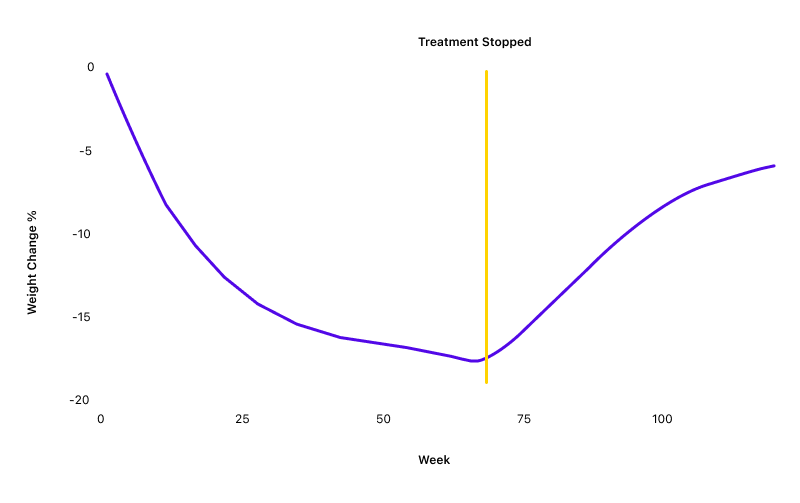
As many as eight out of ten people who lose weight using GLP-1 medication end up gaining it back the data shows, consistently, across multiple large clinical trials. And the reason it keeps showing up is because the cause is biological.
The STEP 1 trial extension followed people on semaglutide who lost an average of 17.3% of their body weight over 68 weeks. A group of them stopped. Within a year, they'd regained two-thirds of it. Blood pressure, blood sugar, cholesterol all drifted back toward where they started.
The SURMOUNT-4 trial on tirzepatide told the same story. 82.5% of people who stopped regained at least a quarter of their lost weight within a year.
GLP-1 medications suppress your appetite by acting on receptors in your brain and gut. You feel less hungry, get full faster, eat less. When you stop, all of that reverses. Your appetite comes back, often stronger than before, because your body has been in a caloric deficit and is now working to recover what it lost. Meanwhile, your metabolism has slowed down during the weight loss. A process called adaptive thermogenesis. You're hungrier and burning less at the same time.
Most people don't plan on stopping. But more than half do within a year, according to a population study in Denmark. The reasons are mostly logistical: cost, insurance gaps, side effects, shortages. JAMA Network Open found that discontinuation is even higher among people using GLP-1s for weight loss rather than diabetes.
So the medication works while you take it. But most people won't take it forever. That gap is where the regain happens.
We built Steadli because we kept seeing this gap go unaddressed. Most health apps focus on tracking: calories, macros, steps, weight. Tracking is easy to build and easy to market. But tracking what you eat doesn't change how you eat. The people who maintain their weight loss are the ones who built different habits while the medication was making it easier to do so, and nobody was helping them do that in a structured way.
A 2024 study out of Copenhagen makes this concrete. Researchers tracked people through a year of GLP-1 treatment, then followed them for another year after everyone stopped. The group that exercised during treatment kept significantly more of their weight loss than the group that only took medication. Even though both groups stopped everything at the same time.
Why? Because the exercise group had a year of repeated behavior behind them. Their bodies changed (more muscle, higher resting metabolism), but their routines changed too.
James Clear calls this identity-based habit change. Eight months of walking after dinner while on medication turns "person who walks after dinner" into your self-image. The medication made those early repetitions easier, but the identity is yours.
Protein is another example. People who get in the habit of eating protein first, at regular intervals, from sources they actually like, tend to keep doing it after their appetite returns. The habit was practiced enough times that it became the path of least resistance.
BJ Fogg's research at Stanford says the same thing from a different angle: make the behavior small enough that it doesn't require motivation, and repetition takes care of the rest.
The window where your GLP-1 is suppressing your appetite is the easiest time you'll ever have to build these habits. You're not fighting hunger while trying to change. That advantage is real, and for most people, temporary.
Steadli gives you small daily actions during that window, grounded in behavior change science, designed to become automatic before your prescription runs out. The medication does its part. Steadli helps you build the habits that keep your progress going.
This post is for informational purposes only and is not a substitute for medical advice. Talk to your prescribing provider about your treatment plan, weight management goals, and the right approach for your situation.
Steadli is a behavior change companion for people on GLP-1 medications. Build the habits that protect your progress before and after your prescription.
Download for iOS Download for Android